
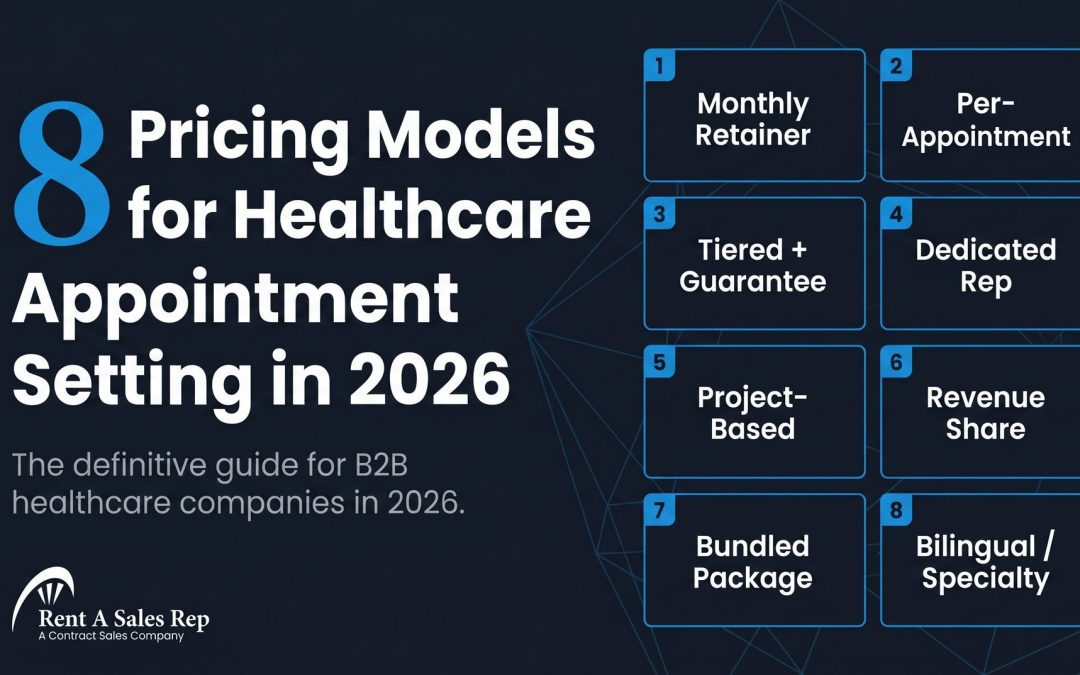
8 Pricing Models for Healthcare Appointment Setting in 2026
Healthcare companies — from medical device manufacturers to health IT vendors — need a steady pipeline of qualified meetings with hospital administrators, clinic directors, and health system decision-makers. But how appointment setting is priced varies widely, and choosing the wrong model can drain your budget or misalign incentives.
Here are the eight most common pricing models you will encounter in 2026, along with the pros, cons, and best-fit scenarios for each.
- Monthly Retainer (Flat Fee)
How it works: You pay a fixed monthly fee for a dedicated sales development team that books appointments on your behalf. The fee covers staffing, training, technology, and management overhead.
Typical range: $5,000 – $25,000+/month depending on team size and scope.
Best for: Companies with $5M-$50M in revenue that want predictable costs and a consistent outbound engine running month over month.
Pros:
- Predictable, budget-friendly cost structure
- The sales team becomes deeply embedded in your product and messaging
- Aligned long-term incentive — the provider is invested in your success, not just volume
Cons:
- Requires a multi-month commitment (typically 3-6 months minimum)
- Results ramp over time; month one is largely onboarding
Why it works in healthcare: Selling into hospitals, nursing homes, and assisted living facilities requires relationship-building and compliance awareness. A retainer model gives reps the time to learn the nuances of your buyer’s world.
- Per-Appointment Pricing
How it works: You pay a set fee for each qualified appointment delivered. “Qualified” is defined upfront — typically by title, organization type, and confirmed interest.
Typical range: $200 – $1,500+ per appointment depending on the target buyer (a meeting with a hospital CFO costs more than one with a department manager).
Best for: Companies testing a new market or product line that want to minimize upfront risk.
Pros:
- Direct cost-per-outcome visibility
- Lower barrier to entry than a full retainer
- Easy to calculate ROI per meeting
Cons:
- Provider may prioritize volume over quality if qualification criteria are loose
- Can become expensive at scale if your close rate is low
- Less strategic depth — the provider is incentivized to book, not to build pipeline intelligence
- Tiered Retainer + Appointment Guarantee
How it works: A hybrid model combining a base monthly retainer with a guaranteed minimum number of appointments. If the provider falls short, credits roll over or fees are reduced.
Typical range: $8,000 – $20,000/month with 10-30 guaranteed appointments depending on tier.
Best for: Mid-market healthcare companies ($10M-$50M revenue) that want both cost predictability and accountability.
Pros:
- Balances risk between buyer and provider
- Guarantees create accountability without pure transactional incentives
- Encourages the provider to invest in quality outreach
Cons:
- “Guaranteed” definitions vary — read the fine print on what counts
- Higher monthly cost than pure per-appointment models
Key consideration: Ask how “guaranteed” is defined. The best providers guarantee qualified meetings with decision-makers (CEOs, CMOs, VPs of Operations), not just any calendar hold.
- Dedicated Rep Model (Staff Augmentation)
How it works: You contract one or more full-time sales development representatives who work exclusively on your account. They operate as an extension of your team but are employed, managed, and trained by the outsourced provider.
Typical range: $4,500 – $8,500/month per dedicated rep.
Best for: Companies that want control over messaging and process but lack the bandwidth or HR infrastructure to hire, train, and manage SDRs internally.
Pros:
- Deep product knowledge and brand alignment
- Full visibility into daily activity, call recordings, and CRM data
- Scales up or down without the pain of hiring/firing
Cons:
- You are still paying during ramp-up (typically 30-60 days)
- Requires your internal leadership to provide direction and feedback
- Project-Based / Campaign Pricing
How it works: A fixed-scope engagement designed around a specific campaign — a product launch, a conference follow-up blitz, entry into a new territory, or a seasonal push.
Typical range: $10,000 – $75,000 per project depending on duration, list size, and complexity.
Best for: Healthcare companies launching a new service line, entering a new region, or following up on a major trade show (HIMSS, HLTH, ViVE, etc.).
Pros:
- Clear scope, timeline, and deliverables
- No long-term commitment
- Ideal for testing outsourced sales before committing to a retainer
Cons:
- Less continuity — the team disbands after the project
- Harder to build deep market intelligence in a short window
- Revenue Share / Commission-Based
How it works: The appointment setting provider earns a percentage of the revenue generated from the deals they source. Sometimes combined with a small base retainer.
Typical range: 5%-15% of closed deal revenue, sometimes with a modest base fee ($2,000-$5,000/month).
Best for: Companies with high average contract values (ACV above $100K) and a proven sales process that can close qualified meetings reliably.
Pros:
- Maximum alignment — the provider only wins when you win
- Lower upfront cost
Cons:
- Harder to find reputable providers willing to work this way without a base
- Attribution disputes can arise on complex, multi-touch healthcare sales cycles
- Long healthcare sales cycles (6-18 months) mean the provider waits a long time to get paid, which can affect effort
- Bundled Sales + Marketing Packages
How it works: Appointment setting is packaged with complementary services — email marketing, LinkedIn outreach, intent data, content syndication, or CRM management — into a single monthly engagement.
Typical range: $10,000 – $35,000/month depending on services included.
Best for: Healthcare companies that lack an internal marketing team and want a turnkey demand generation engine, not just cold calling.
Pros:
- Integrated approach increases touchpoints and conversion rates
- Single vendor simplifies management
- Multi-channel outreach (phone, email, LinkedIn, direct mail) performs better in healthcare where decision-makers are hard to reach
Cons:
- Less flexibility to swap out individual components
- Harder to isolate which channel is driving results
- Higher total investment
- Bilingual / Specialty Market Pricing
How it works: Premium pricing for appointment setting teams with specialized capabilities — bilingual reps (English/Spanish), reps with clinical or technical backgrounds, or teams with existing relationships in specific healthcare verticals.
Typical range: 15%-30% premium over standard pricing models listed above.
Best for: Companies selling into diverse patient populations, border-state health systems, or highly technical buyers (biomedical engineers, clinical informaticists) where credibility on the phone matters.
Pros:
- Access to underserved markets that competitors overlook
- Higher conversion rates when reps speak the buyer’s language — literally and figuratively
- Competitive differentiation in crowded healthcare verticals
Cons:
- Smaller talent pool means longer ramp times
- Premium cost requires higher deal values to justify ROI
Pricing Model Comparison
| Model | Monthly Cost Range | Best For | Risk Level | Time to Results |
| Monthly Retainer | $5K – $25K | Sustained pipeline building | Low | 60-90 days |
| Per-Appointment | $200 – $1,500/appt | Market testing | Medium | 30-45 days |
| Tiered + Guarantee | $8K – $20K | Accountability + predictability | Low-Medium | 45-60 days |
| Dedicated Rep | $4.5K – $8.5K/rep | Control + brand alignment | Low | 30-60 days |
| Project-Based | $10K – $75K total | Launches + events | Medium | 15-45 days |
| Revenue Share | 5%-15% of revenue | High-ACV deals | High | 90-180 days |
| Bundled Package | $10K – $35K | Turnkey demand gen | Low-Medium | 60-90 days |
| Bilingual / Specialty | 15%-30% premium | Niche markets | Low | 45-75 days |
—
How to Choose the Right Model
When evaluating pricing models for healthcare appointment setting, consider these factors:
- Your sales cycle length — Healthcare deals often take 6-18 months. Models that require quick ROI proof (like pure per-appointment) may not account for the full value of pipeline built.
- Your average deal size — If your ACV is above $100K, you can afford premium models and should prioritize quality over volume. Below $50K ACV, cost efficiency matters more.
- Your internal sales capacity — If you have strong closers but no prospecting team, a dedicated rep or retainer model fills the gap. If you lack both, a bundled package makes more sense.
- Your target buyer — Reaching CEOs, founders, and C-suite executives at healthcare companies requires a different approach (and price point) than reaching department heads or facility managers.
- Your growth stage — Early-stage companies benefit from project-based or per-appointment models to test messaging. Established companies with proven product-market fit should invest in retainers or dedicated teams for sustained growth.
Bottom line: The most effective healthcare appointment setting partnerships are built on transparency, clear qualification criteria, and a pricing model that aligns incentives between both parties. The cheapest option is rarely the best — and the most expensive one is not automatically the most effective. Choose based on fit, not just cost.